
| Home | Butterflies | Birds (media) | Flora and Fauna | My 5 Chickens | Daily | Spontaneous | About |
| Dragonflies | Other Photos | Observations | Species | Mexican birds | Checklists | TBP | Links |
Species account
Common Darter
(Sympetrum striolatum)
(Charpentier, 1840)
Skimmers (Libellulidae) [Dragonflies] CODA 24829
Skimmers (Libellulidae) [Dragonflies] CODA 24829
Stor Hedelibel (dk)
Alguacil Estriada (es)
Större Ängstrollslända (se)
Synonyms (common):
Libélula Estriada (es) Stor Ängstrollslända (se)
Synonyms (scientific):
Libellula ruficollis Charpentier, 1840
Libellula macrocephala Selys, 1841
Diplax commixta Selys, 1884
Sympetrum subpruinosum Kirby, 1886
Sympetrum nigrescens Lucas, 1912
Sympetrum durum Bartenev, 1916
Sympetrum striolatum doshidorzhii Belyshev, 1958
Subspecies
commixtum
(Selys, 1884) - China, India. Venation dark brown, otherwise like nominate [valid?]
nigrescens
Highland Darter. Lucas (1912) - Atlantic coast of Ireland, Scotland and Norway, isle of Man, Åland-islands and S Finland (also elsewhere in Fennoscandinavia and Denmark). Darker legs, more pronounced moustache with a thick spot at the lower end and stronger black markings on the side of the thorax with yellow spotting, somewhat like danae.
Measurements:
To 33-44mm Ab 20-30mm Hw 24-30mm
Generations:
Flight period:
(?):When compiling flight periods myself I mainly use citizen science data, and if so, limit to include records that have already been validated.
| J | F | M | A | M | J | J | A | S | O | N | D | |||||||||||||||||||||||||||||||||||||||||||||||||||||||||||||||||||||||||||||||||||||||||||||||||||||||||||||
| Scandinavia | ||||||||||||||||||||||||||||||||||||||||||||||||||||||||||||||||||||||||||||||||||||||||||||||||||||||||||||||||||||||||
| Europe | ||||||||||||||||||||||||||||||||||||||||||||||||||||||||||||||||||||||||||||||||||||||||||||||||||||||||||||||||||||||||
Identification:
2020-09-13
Mostly similar to Moustached Darter (Almindelig Hedelibel) with yellow on legs. But present species does not have the black marking running down the central side of the eye, as does Moustached (hence the name). And the vulvar scale (below S9-10), on the female, of present species shows a weaker angle to the abdomen. And apparently the narrow waist of the male is less so than on Moustached. Also, the old male shows two isolated yellow patches on the side of the thorax, where Moustached is more uniform dark red.
But variation and overlap occur.
Similar species:
Life stages:
The mating takes place near the water hole, and takes place in the vegetation and lasts 10-15 minutes. The pair then flies in tandem low over the shore vegetation, wet or dry part, and the eggs are dropped while the male swings the female. Sometimes they detach and the female completes the process by herself. The eggs overwinter and hatch the following spring, where the larvae develop during 3-4 months (same season). The imago-transformation takes place low on plants in or near the water, and simply in the grass next to the shore.
Distribution:
(?):Altitude is often taken from a specific localized resource, why the true entire range very likely is wider.
Most of Europe; absent northern Scandinavian peninsula and most of Finland. Also present in NW Africa and east through Turkey, the Middle East, Iran, Kazakhstan, Mongolia to Korea and Japan. In Denmark widespread and present in all regions.
Habitat:
Behavior:
Endemic:
Redlist
(?):NE: Not evaluated
NA: Not applicable
DD: Data deficient
LC: Least concern
NT: Near threatened
VU: Vulnerable
EN: Endangered
CR: Critically endangered
EW: Extinct in the wild
EX: Extinct
RE: Regionally extinct
NA: Not applicable
DD: Data deficient
LC: Least concern
NT: Near threatened
VU: Vulnerable
EN: Endangered
CR: Critically endangered
EW: Extinct in the wild
EX: Extinct
RE: Regionally extinct
LC(global) LC(eu) LC(EU) LC(dk)
Status:
Common in Denmark and Europe in general, with an expanding tendency in the north. In the beginning of the 20th century it was considered somewhat rare in Denmark, especially in the eastern parts of the country. That status has changed now, as the number of records continue to grow. Vulgatum used to be the more common, but is now the rarer species of the two.
Comment:

|
2151
(1 photos)
2023-08-05 Ny Sebberup Skov (Hedensted), Denmark Imago Not sure about the sex. |

|
462
(1 photos)
2020-07-13 Kalvebod Fælled (Tårnby), Denmark Imago Male Young male with narrow waist and black tattoo mark on frons (not being part of the moustache). |

|
463
(3 photos)
2020-07-13 Kalvebod Fælled (Tårnby), Denmark Imago Male Young individual |

|
464
(2 photos)
2020-07-13 Kalvebod Fælled (Tårnby), Denmark Imago Male Young. Assuming this species by very narrow yellow stripe on front legs. |

|
465
(1 photos)
2020-07-13 Kalvebod Fælled (Tårnby), Denmark Imago Male Young individual |

|
518
(2 photos)
2021-07-07 Kalvebod Fælled (Tårnby), Denmark Imago Male Restricted black down side of frons, yellow on legs and black framed rectangle on side of thorax. |

|
1178
(2 photos)
2022-07-16 Kalvebod Fælled (Tårnby), Denmark Imago Male |

|
1175
(1 photos)
2022-07-17 Kalvebod Fælled (Tårnby), Denmark Imago Male |

|
1179
(2 photos)
2022-07-17 Kalvebod Fælled (Tårnby), Denmark Imago Male |

|
1160
(1 photos)
2022-11-05 Kongelundsområdet (Dragør), Denmark Imago Male Skovfogedmarken. Practically the only species flying on Amager now. |

|
1161
(3 photos)
2022-11-05 Kongelundsområdet (Dragør), Denmark Imago Male Skovfogedmarken. An animal with a damaged eye. As if it's been punched in. Apparently it didn't have problems flying and attacking another male. Aberrant |

|
2209
(1 photos)
2023-08-17 Krebseklo-vandhullet/kirkegård (Hørsholm), Denmark Imago Male Young male. |

|
2253
(2 photos)
2023-08-24 Kalvebod Fælled (Tårnby), Denmark Imago Male Pinseskoven. |

|
2264
(1 photos)
2023-08-24 Kalvebod Fælled (Tårnby), Denmark Imago Male Pinseskoven. |

|
2262
(2 photos)
2023-08-24 Kalvebod Fælled (Tårnby), Denmark Imago Male Pinseskoven. Young individual. |

|
2273
(2 photos)
2023-08-26 Kalvebod Fælled (København), Denmark Imago Male Fasanskoven. |

|
2377
(2 photos)
2023-09-14 Travbaneparken, Denmark Imago Male Plejehjemsdammen. A fairly typical mature male, but still very similar to the male vulgatum [Almindelig Hedelibel] in 2375 of the same day. However, notice the difference in amount of yellow on the legs, and the black moustache down the side of the eye plus the more yellowish contrasting ovals on the side of the thorax of the striolatum. |

|
2376
(2 photos)
2023-09-14 Travbaneparken, Denmark Imago Male Plejehjemsdammen. A fairly typical mature male. |

|
2371
(1 photos)
2023-09-17 Kalvebod Fælled (Tårnby), Denmark Imago Male Sporet. Mature. Restricted yellow on the legs, restricted black moustache and the yellowish thorax ovals well defined point in the direction of striolatum. A rather skinny specimen with an almost club-shaped abdomen - more like sangineum [Blodrød Hedelibel]. |

|
2370
(3 photos)
2023-09-17 Kalvebod Fælled (Tårnby), Denmark Imago Male Sporet. Mature. The amount of yellow on the legs is difficult to ascertain on this old individual but the restricted black on the frons in dense color combined with the paler dark bulb further down the eye-side is good for the species. |

|
2386
(3 photos)
2023-09-21 Kalvebod Fælled (Tårnby), Denmark Imago Male With half a second right leg. I don't recall seeing many animals with damaged legs, so with two today, 2385, this is quite unusual, I think. Are the animals more fragile now, more aggressive toward eatch other or could the fact that bird migration is high right now be causing more injuries by birds chasing them? About species, many of these old males can be tricky to separate, compared to vulgatum [Almindelig Hedelibel], but apart from the classic features this one also shows the details of the secondary genitals, pointed spikes, that support striolatum better than vulgatum that shows more of a lump with two points. Aberrant |

|
2388
(2 photos)
2023-09-24 Hvidovre Strandenge, Denmark Imago Male Blurry dark markings on the eye are not part of the moustache. |

|
2389
(1 photos)
2023-09-24 Hvidovre Strandenge, Denmark Imago Male Mature. With the black blob down below the moustache that some individuals have. |

|
2390
(1 photos)
2023-09-24 Hvidovre Strandenge, Denmark Imago Male Mature. Restricted yellow on the legs and again an individual with the black blob below the moustache. |

|
2405
(1 photos)
2023-09-30 Amager Fælled, Denmark Imago Male Practically the only darter that flies on Amager now. |

|
2724
(6 photos)
2024-06-03 Travbaneparken, Denmark Imago Male Lille regnbassin. My first thought was that it was a striolatum because of the limited moustache, but the extensive amount of yellow on the front legs doesn't go well with that species, and should rather be found on a vulgatum [Almindelig Hedelibel]. Lars Johansen mentions that the darkish bulb on the frons below the black moustache is a qualifying character for striolatum, never seen on vulgatum, why he also sees it as a striolatum. That variation exists on leg coloration is known, but is it just randomly so, or does it happen under certain circumstances? I've tried to find similar-looking animals online, resulting in a similar animal on a Polish site. And looking through my own material I found another one with much yellow on the legs, 2209. All of these are in their earliest stages where the wing marks are still mostly white. The big question then is, whether they keep the yellowish legs throughout their adult life or if they eventually darken to look more like the normal legs with only a yellow line on the back of the legs? If they do go through a process from much to little yellow as being the normal development, I guess, many more pale-legged individuals would have been found, why it is inviting to believe that we are talking about a naturally occurring deviation. Unless you take another perspective on the matter: Knowing that cross-species interaction does occur, and expecting that some of that action sometimes actually leads to a successful breeding outcome, it could also mean that these animals in fact could be hybrids?! ...Will keep investigating. |

|
3068
(3 photos)
2024-11-14 Søvang, Denmark Imago Male Vandhullet. Latest for me ever. I've been around looking for them during the first half of November, but except for the first few days I've found none. All because of the weather we've had lately, with typical overcast and dark conditions without a single ray of sun for almost two weeks in a row. Expected but still depressing. On the positive side we've been spared for rain and strong winds. But today the sun came out and I must admit that I had expected more animals to show up, taking the large numbers I had late in October into consideration. But not a single animals at all the good spots on Kalvebod Fælled, why I'm grateful that I at least got this one. I didn't disturb the animal, though I'm not sure it would have reacted if I had. Flat, like glued to the rock trying to absorb as much energy from it as possible. Air temperature today was about 10C, and the temperature on the rock can't have been much higher since the sun was in a haze and the wind was fresh. |

|
3416
(2 photos)
2025-11-01 Kalvebod Fælled (Tårnby), Denmark Imago Male SHV-svenskesø. Left wings dorsal view, Fw 31mm Hw 29,5mm. Measured from the fixation point along the costa (leading edge) to the tip of wing. The yellow tint is how most striolatum normally look at this time of the season, though probably exaggerated here because the photos were taken a day after finding the animal, knowing that dead animals normally loose their colors and darken. Wings |
|
10157
(18 photos)
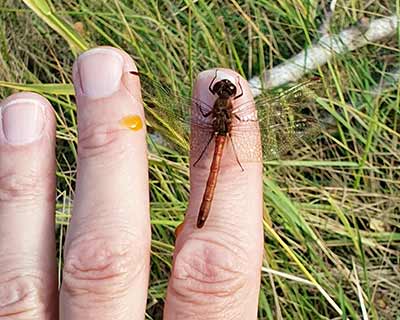
2026-10-03 Kalvebod Fælled (Tårnby), Denmark Imago Male SHV-lysningerne. What an unusual experience! Even with my binoculars I had a doubt when looking at this animal, the black moustache being somewhat in-between that shown by striolatum and vulgatum, only seeing the left side. So I decided to catch it to get a close-up look. In-hand I was still somewhat puzzled by the rather elongated moustache that looked solid down the eye and not just a ghosting shadow along the frons. So I decided to get photos of this, to have documentation showing that it is not always straight forward to make a solid id. Particularly from photos, where some people tend to accept what looks obvious from a single photo to make their conclusion. Me not like. And then, while concentrating on taking the photos with my mobile (not easy with difficult angles and the autonomic life of an auto-focus created in South Korea many years ago). At one point I noticed that the animal was holding its tail up to the head, thinking it was just using the time to clean-up while not being able to get away. But then it started to act strangely. As if it was about to collapse. And then I saw the yellow liquied coming out from the tip of the abdomen, above the appedages. Ufff! That was unusual and did not look good. Apparently it had been chewing on itself rather than cleaning up. Three large drops of this warm yellow liquid came out. A very large amount comparing to the size of the animal, and I was sure that it was about to die now (The liquid is called haemolymph, and acts like vertebral blood, though in dragonflies it does not transport oxygen). It is reasonable to believe that the animal behaved like this out of stress of being captured and held firmly. But still, I've done it many times without seeing anything like this behavior. The only difference I can think of, was that I happened to grab the wings much closer to the base, than I normally would, and I wonder if that could have created some kind of pressure on the muscules and the thorax, provoking it to act this radically. I tried to put the animal down, but then it almost clung to my finger, as the photos show, and there it got quiet, lowering the wings, and looked very much dead for a while. But then it moved the head and did so with intervals. I was rather touched by the experience so I just sat there for several minutes, both thinking about what to do and to see what would happen. At least I owed it to have as peaceful a death as possible, now that I had caused this shocking and uacceptable situation. Of course it would have no chance to go back to the normal life of a male dragonfly, especially with the appendages now just dangling at the end, looking very uncontrollable with the nerval connections probably chewed to pieces. And then when I was sitting there fealing very guilty, it suddenly flew away. Fast and deliberately. Up high and very far away from this clumpsy monster. Welcome to the planet! We please to aim you! About the original intention for capturing the animal, I must say that I'm still not a hundred percent sure about the id. The moustache on the left side looks very solid down the eye, and from certain angles it looks like it would on a vulgatum, though, on the short side. But from other angles the quality of the black changes, and becomes more ghostlike, like seen on the striolatum. But looking at the right side of face, that moustache there looks more restricted and conforms much better to a normal striolatum. I decide to call it a striolatum because the overall evidence and probabilities point in that direction, but knowing that there is much more to be said about hybrids, for example, in the odonate world, I can't say that I'm not thinking a vulgatum could have been involved in the creation of this unfortunate creature. Mobile photos. Aberrant Damaged |

|
425
(3 photos)
2020-07-13 Kalvebod Fælled (Tårnby), Denmark Imago Female Young. I first id'ed this female as a vulgatum because it looks like the moustache is running long down the eye-side and ends pointed. But both the limited and yellow on the front legs and the shape of the vulvar scale suit a striolatum better. Normally the saying is, that the moustache has precedence over the other features, but I believe this example is the exception to the rule. |

|
466
(1 photos)
2020-07-14 Kalvebod Fælled (Tårnby), Denmark Imago Female Young. The black rectangle on the side of the thorax is not so strongly marked, but the shape of the vulvar scale is spot on for the present species, as is the short moustache between the eye and frons. |

|
563
(2 photos)
2021-08-01 Amager Fælled, Denmark Imago Female Younger. The well-defined short moustache is somewhat obscured by the black bleeding into the frons. |

|
1177
(1 photos)
2022-07-17 Kalvebod Fælled (Tårnby), Denmark Imago Female |

|
1176
(2 photos)
2022-07-17 Kalvebod Fælled (Tårnby), Denmark Imago Female |

|
1104
(1 photos)
2022-07-17 Kalvebod Fælled (Tårnby), Denmark Imago Female |

|
1690
(1 photos)
2023-06-24 Grusgrav ved Mogenstrup (Sjælland), Denmark Imago Female |

|
2042
(2 photos)
2023-07-27 Skær Sø (Egtved), Denmark Imago Female Some might say that the dark markings, moustache, down the side of the frons should indicate a Moustached Darter [Almindelig Hedelibel], but this combination with the dark spot midway down the side is well-known for striolatum. Besides, the well-marked black rectangle on the side of the thorax is also better for striolatum, as is the narrow yellow line on the back on the forelegs. Damaged |

|
2206
(3 photos)
2023-08-16 Kongelundsområdet (Dragør), Denmark Imago Female Skovfogedmarken. A single mature female as they often appear. |

|
2261
(2 photos)
2023-08-24 Kalvebod Fælled (Tårnby), Denmark Imago Female Pinseskoven. Mature individual. |

|
2274
(3 photos)
2023-08-26 Kalvebod Fælled (København), Denmark Imago Female Fasanskoven. |

|
2279
(4 photos)
2023-08-26 Kalvebod Fælled (København), Denmark Imago Female Fasanskoven. |

|
2369
(1 photos)
2023-09-17 Kongelundsområdet (Dragør), Denmark Imago Female Msø. |

|
2391
(3 photos)
2023-09-24 Hvidovre Strandenge, Denmark Imago Female Mature. Typical specimen: Limited moustache, limited yellow on the legs, strongly colored yellow on the lower part of the thorax ovals and the shape of the valvular scale. |

|
2406
(4 photos)
2023-10-16 Travbaneparken, Denmark Imago Female Plejehjemsdammen. Egg-dropping alone and then took a rest. |

|
2765
(3 photos)
2024-06-07 Kalvebod Fælled (Tårnby), Denmark Imago Female Villahøj. Teneral. With a focus on the variety of extent of yellow on the front legs this female is interesting, because it looks like there is more yellow on the left front leg than on the right one. In general it has more yellow than is normally attributed to the species, but since it is a young animal, still with white wing marks, it follows what I like to see as a pattern where the very young animals do show this pattern. See 2724 for comparison with a young male. The moustache pattern follows the same as on 2724 with the blurry bulb on the frons below the moustache. |

|
3016
(1 photos)
2024-08-05 Kongelundsområdet (Dragør), Denmark Imago Female Nordskoven. |

|
3061
(2 photos)
2024-09-29 Kalvebod Fælled (Tårnby), Denmark Imago Female Pinseskoven. The black moustache down the eye is part of the color of the frons, and therefore the moustache is short and better suited for a striolatum than a vulgatum [Almindelig Hedelibel]. However, the strong shadow along the eye is the major point of confusion here, and a good example of how important it is to get to see the facial details well, and preferably from more angles before reaching for an identification. The limited pale color on the front leg femur, is also in favor of a striolatum. |

|
3054
(2 photos)
2024-10-18 Kongelundsområdet (Dragør), Denmark Imago Female Troldelysningen. This female shows an aberrant eye color. The lower part of the eye is normally olive green, but here dark bronzy; more similar to what is seen on the male Black Darter [Sort Hedelibel]. The rest of the animal looks normal, and it behaved like the others present today, sunning on the circled stones and flying and maneuvering without difficulties. Aberrant |

|
3371
(3 photos)
2025-08-22 Gjerrild (djursland), Denmark Imago Female Hestehave-vandhullerne. Form nigrescens. Tentatively calling it this form, being a dark individual that is not too mature to obscure the color tones, and the femurs showing almost no yellow and the center part of the side of the thorax is lined in thick black with yellow center spots, plus the thick black spot under the short moustache. Aberrant |

|
3398
(2 photos)
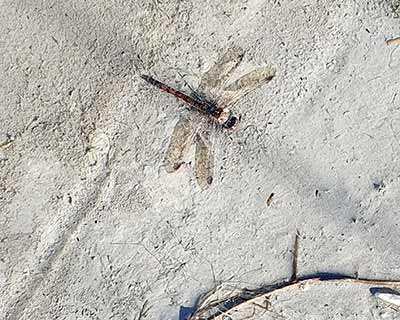
2025-09-28 Kalvebod Fælled (København), Denmark Imago Female Bro-vandhullet. When I saw this animals the tail looked bluish, and I was almost sensing Orthetrum vibes. But closer up it was a darter, and I think the substance on wings and the last abdominal segments might be slime from a snail or other type of insect/animal. Aberrant |
|
10163
(3 photos)
2026-10-04 Kalvebod Fælled (Tårnby), Denmark Imago Female Engsø. Was lying in the water looking very dead. I couldn't imagine otherwise while it was lying there motionless in the cold water. But as you can see it look fresh, and I was glad to add it to the collection of other self-dead individuals for further investigations of various sorts later on. So I put it in my little container and continued my round-trip. And then at home I opened the container to move it to a more permanent box. But then while showing it to my mother, it suddenly started to move the front legs, as if cleaning the eyes. It also looked like it had managed to turn around, as I'm pretty sure I put on the paper with the back downward. So, brought to live again by the warmth, I dicided to release it at the nearest good spot for the species, Travbaneparken, where I left it sheltered at the bottom of a large sun-exposed rock. |

|
1122
(1 photos)
2022-08-17 Kalvebod Fælled (Tårnby), Denmark Imago Male & Female In tandem. Flying egg-dropping mode. |

|
3070
(4 photos)
2024-08-26 Travbaneparken, Denmark Imago Male & Female Egg-dropping. |

|
3053
(3 photos)
2024-09-29 Kalvebod Fælled (Tårnby), Denmark Imago Male & Female Svenskeholmvej øst, lysning. I often find the late darters anxious and very wary, but today, in the sun and out of the wind, they were completely confident, also landing on my head and my back, taking advantage of my heat radiation, I guess, and a more sun-exposed position out of the tall grasses. With a delightful pooh-package gratifyingly dropped at the root of my little finger! Hands on |

|
3291
(10 photos)
2025-07-01 Travbaneparken, Denmark Exuvia Lille regnvandsbassin. Bulky mask;Regularly toothed labial palps; Half-domed eye-shape; S9-side-thorn longer than cerci; Bristle-crests on underside of S7-8 (difficult to see); S8-side-thorns longer than a third of the length of S8; Size and shape. Striolatum and sanguineum are the only sympetrums flying here now. A Sanguineum would show the S8-side-thorn shorter than a third of S8. Only one exuvia found, but several imagines. Exuvia |