
| Home | Butterflies | Birds (media) | Flora and Fauna | My 5 Chickens | Daily | Spontaneous | About |
| Dragonflies | Other Photos | Observations | Species | Mexican birds | Checklists | TBP | Links |
Species account
Baltic Hawker
(Aeshna serrata)
Hagen, 1856
Hawkers (Aeshnidae) [Dragonflies] BAHA 24803
Hawkers (Aeshnidae) [Dragonflies] BAHA 24803
Baltisk Mosaikguldsmed (dk)
Vassmosaikslända (se)
Synonyms (scientific):
Aeschna osiliensis Mierzejewski, 1913
Aeschna fennica Valle, 1927
Measurements:
To 75-81mm Ab 50-62mm Hw 47-53mm
Generations:
Flight period:
(?):When compiling flight periods myself I mainly use citizen science data, and if so, limit to include records that have already been validated.
| J | F | M | A | M | J | J | A | S | O | N | D | |||||||||||||||||||||||||||||||||||||||||||||||||||||||||||||||||||||||||||||||||||||||||||||||||||||||||||||
| Scandinavia | ||||||||||||||||||||||||||||||||||||||||||||||||||||||||||||||||||||||||||||||||||||||||||||||||||||||||||||||||||||||||
| Europe | ||||||||||||||||||||||||||||||||||||||||||||||||||||||||||||||||||||||||||||||||||||||||||||||||||||||||||||||||||||||||
Identification:
Similar species:
Life stages:
The females inserts the eggs into stems of phragmite plants above the water surface. The eggs [likely] overwinter and hatch the following spring. The larvae develop during 2-?years. The imago-transformation takes place near the water low on the vegetation.
Distribution:
(?):Altitude is often taken from a specific localized resource, why the true entire range very likely is wider.
Patchily Baltic region including NW Denmark, Sweden, Finland and Estonia. Also Russia across the continent to the far east and Georgia, Kazakhstan, Kyrgyzstan and Mongolia. In Denmark registered in the wetland-complex Vejlerne in NE Jylland.
Habitat:
Behavior:
Host plants:
Reed (Phragmites)
Endemic:
Redlist
(?):NE: Not evaluated
NA: Not applicable
DD: Data deficient
LC: Least concern
NT: Near threatened
VU: Vulnerable
EN: Endangered
CR: Critically endangered
EW: Extinct in the wild
EX: Extinct
RE: Regionally extinct
NA: Not applicable
DD: Data deficient
LC: Least concern
NT: Near threatened
VU: Vulnerable
EN: Endangered
CR: Critically endangered
EW: Extinct in the wild
EX: Extinct
RE: Regionally extinct
LC(global) LC(eu) LC(EU) VU(dk)
Status:
First time registered in Denmark was in 2006 in Vejlerne, Nordjylland, and ever since it has been restricted to this part of the country. The first ten years numbers up to 40-50 could be registered, but since then it seems like the population has been shrinking, and in recent years it has been complete absent or just a single or few individuals found in a season. In 2023 1 was found, in 2024 0, but a small handful was present again in 2025, giving hope that the species will manage to survive.
It is a mystery why it hasn't been able to spread to other parts with similar conditions, as there appear to be many suited sites spread out in the region and the country.
It is a mystery why it hasn't been able to spread to other parts with similar conditions, as there appear to be many suited sites spread out in the region and the country.
Comment:
It is a small mystery why the species has only managed to establish itself in the reedbeds of Vejlerne, knowing that many similar and apparently suited localities exist throughout the country. Could freezing cold winters be a requirement, knowing that the distribution is continental and northern?
Articles:
|
3306
(1 photos)
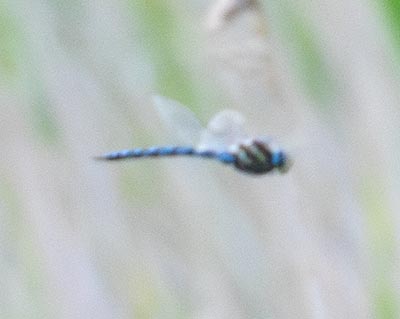
2025-07-19 Han Vejle (skjulet), Denmark Imago Male No Baltic Virgin No more! [Last seen at the site in 2023]. I went there with the hope to easily find and photograph the species after it had been reported the day before. But what should a have been an quick in-and-out operation ended with a 6-hour quest where I only managed to achieve this pour result! For reasons, I had to move about at the perimeter, using the boardwalks not leading to the hide, where the Friday encounter had taken place. But that was not bad in itself. The observation-platform raising above the reed-forest gives a good overview, and from there I managed to spot two males and a female. But unfortunately only when they were in the air racing from one spot to the other - in-between imperators [Stor Kejserguldsmed]and grandis [Brun Mosaikguldsmed] that were also occupying the airspace. Add in that the harsh sunlight made it difficult to perceive details well, and add in that my faulty camera cannot focus manually anymore and add in that the autofocus pointing at a uniform wall of greenery at 20 meters distance is now an impossible task for this outdated Japanese to handle, why I decide to be greatful that I managed to get this shot! Blurred out, yellowish ovals and blue abdomen and eye could also have been a mixta [Efterårs-mosaikguldsmed] at this site, but the size was as big as the other two air-acrobats mentioned before and the hanging abdomen in flight is not normally seen on a mixta, why I dare my tick, and call it my species number 56 in Denmark. The female I saw, came closer and the well-marked long thorax ovals were obvious. However, grandis also show this feature why it was not as straight forward to pin out a serrata as it might sound. But what I seemed to learn was that grandis looked more opaque, whereas the serrata female looked glistening dark greenish-brown. Apparently there was a tendency for all the larger dragonflies to forage and patrol along the edge of the sedge-forest, near the open water, which is also why it made sense to place yourself at the hide. Later, just before I left, I had both a male and a female that came in and landed out of sight in-between the sedges not far from the platform. Sometimes people get luckily and find animals perched along the boardwalk. Rare |