Natural protected Area (Wildlife refuge).
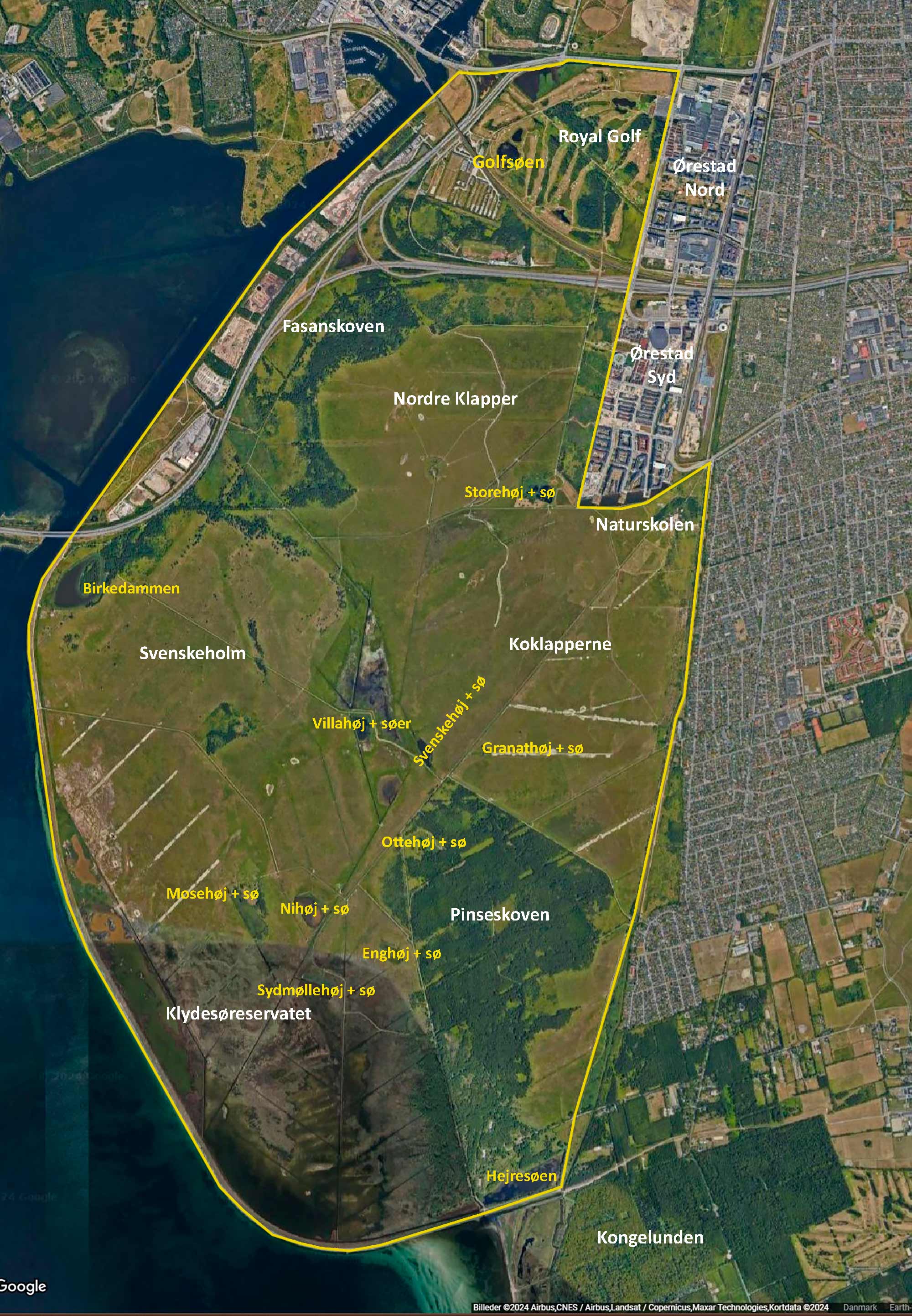
Used to be coastline and shallow waters intermixed with smaller islands. Was reclaimed during World War II when a dike was constructed along the western perimeter. Was a military shooting range for several decades (has been cleaned for defects), but given over to civil recreational use in the mid 80'es. A large part has since then been expropriated in the northeast to be able to build the new neighborhood Ørestad, and the northernmost part is today a golf course (with public access). Size approximately 25 km2. The map shows the main areas and the hills with adjacent lakes, characteristic of the area. The red overlay represents Klydesøreservatet, a bird sanctuary without access. For detailed maps, see the photo section below.
The area consists of a variety of habitats including shallow lakes, ponds, birch forests, open grassland (e.g. Wood Small-Reed [Bjerg-Rørhvene]) intermixed with large thickets of mainly hawthorn [tjørn] and sea-buckthorn [havtorn]. The forest, Fasanskoven, is found at the northeast corner of the area, along the highway, and the other, and larger forest, Pinseskoven is found in the southeast, occupying almost a quarter of the area. The southwest corner of the reserve, bordering the dike, is a shallow lagoon and adjacent grassing fields working as a bird reserve with no access to the public (but can be overlooked from the perimeter, especially from lookouts on top of the dike). In-between you'll find several short-grassed hills, that used to work as shooting targets when the military was still here. With all the hills there is a corresponding lake.
The ground level of the area is below sea level, which is easy to appreciate when standing on top of the dike along the western perimeter. The level is controlled by pumps, and regulated to maintain a level that secures that all the lakes are permanently wet. If possible. Because, it is only regulated oneway, to remove excessive amounts of rain water, and never to let sea water enter to flood the area, why in dry years you will see that particularly Klydesøen and the meadows around Villahøj get very dry. In severely dry years Hejresøen has dried up too and Granatsø normally also reduce drastically, though never completely. The lack of rain in our area seems to have become a permanent factor as a result of the climate changes.
The area is mainly being maintained with recreational purpose in mind, and is heavily transected by roads and paths. To avoid forestation of the open areas, mechanical maintainance as well as grass-eaters are used. Cattle, sheep and horses are grassing throughout the summer. There has been a substantial increased pressure on the area during the last years from more and more city people wanting to get out to explore and use nature.
INTERESTS:
Birds, butterflies, dragonflies and flora and fauna in general. Also very popular with bike-racers, joggers and outdoor enthusiasts taking advantage of the many shelters that have popped up throughout the area.
BIRDS:
All types of birds can be found here. Especially water birds in the reserve, Klydesøen, where three observation 'towers' have been build on top of the dike giving good views overlooking the area. You need a scope to be able to see the birds well, since they are often far away (up to a kilometer). The same is the case at Villahøj, also a flooded area good for all types of waterbirds. Pinseskoven is good for passerines, and during migration you can find a variety of species passing through: raptors, geese, ducks and a host of passerines. See dofbasen.dk or fuglepaakalvebodfaelled.dk for more information.
DRAGONFLIES:
The area is excellent for dragonflies, with 34 of the 36 species seen on Amager having been recorded here. The size and the combination of habitats is the main reason for this richness. As the maps indicate there are a lot of micro sites where to look for them, depending on which species you are interested in. Below I'm presenting all the regular sites that I visit regularly during the season, adding the species seen. For a more precise presentation of each species, visit the page with Dragonflies on Amager.
Bagstien:
dryas, affinis, cyanea, mixta, imperator, pratense, isoceles, aenea, depressa, quadrimaculata, cancellatum, sanguineum, striolatum, vulgatum (14) -- This forested trail gets wet in winter and early spring. A mix of willow and birch it appears to be more attractive to maturing animals than other parts of the forest. As one of the few forest localities affinis has been seen here on several occasions, confirming that the species is not just an open habitat species, but follows the normal behavior of maturing animals. Early in the season it is a good spot to look for pratense, and in autumn it is one of the best locations to look for late darters, especial striolatum that often sit exposed on the dead branches bordering the trail. Or directly on you, if you stand still! A single observation of dryas should be considered accidental.
Birkedammen:
viridulum, imperator, parthenope, quadrimaculata, cancellatum, sanguineum, striolatum (7) -- Parthenope is seen here once, otherwise only the most common species in moderat numbers. Being completely reed-fringed, the lake isn't that attractive in terms of dragonfly-studies.
Barbarus-vandhullet:
barbarus, dryas, sponsa, pulchellum, viridulum, elegans, pumilio, affinis, mixta, imperator, depressa, quadrimaculata, cancellatum, sanguineum, striolatum, vulgatum (16) -- The waterhole where barbarus was discovered in good numbers for the first time. This was in 2024. Unfortunately 2025 gave none at all.
Barbarus-renden:
barbarus, dryas, sponsa, elegans, affinis, mixta, cancellatum, sanguineum, striolatum (9) -- This was where most pairs of barbarus were found during the 2024 discovery. Unfortunately no animals were found in 2025. Also a good locality for dryas. And also a good locality for affinis with presence in 2024 and egg-laying witnessed in 2025.
Bro-vandhullet:
sponsa, pulchellum, cyathigerum, elegans, mixta, imperator, sanguineum, striolatum, vulgatum (9) -- A small modest reed-fringed waterhole. Most numerous species being cyathigerum.
Dryas-renden:
dryas, sponsa, puella, cyathigerum, elegans, pumilio, affinis, mixta, depressa, quadrimaculata, cancellatum, sanguineum (12) -- This short ditch, 50 meters, normally dry out in summer and is by far the best locality for dryas on the island. Hence the name. Sponsa can be found as well but in much smaller numbers, as there is a tendency for the two to divide suited localities between them, one always being more present than the other. The affinis seen here was a single animal flying around with a flock of mixta between the ditch and the nearby forest edge.
Engsø:
barbarus, sponsa, puella, cyathigerum, najas, viridulum, elegans, pumilio, mixta, imperator, pratense, isoceles, depressa, quadrimaculata, cancellatum, fonscolombii, sanguineum, striolatum, vulgatum (19) -- Excellent site. 150 x 70 meters wide, shallow, but permanent lake. The vegetation in the water and along the edges is limited, why the surface merges almost seemlessly with the surrounding grassland. When there is an influx of , the species is often breeding here, as the only place on the island - latest both in 2024 and 2025. Viridulum is also common here, with a peak count one day in 2023 of 700. A single barbarus was found in September 2025, and pumilio is still seen on a rare occasion, though it used to be more common at this part of the island in 2022-2023. Another very common species here is cancellatum. 50+ males can be present, either perched on the ground near or on the wall of the adjacent hills or patrolling over the lake.
Fasanskov-lysningen:
cyanea, mixta, imperator, vulgatum (4) -- Clearings in beech forest. Moderate numbers seen here, being rather far from any potential breeding sites.
Flaveolum-lysningen:
imperator, pratense, depressa, cancellatum, flaveolum, sanguineum, striolatum, vulgatum (8) -- A permanently long-grassed clearing that got its name for the discovery of several flaveolum in 2020. That turned out to be a single time event, and since then the place has been rather disappointing in terms of diversity. But it is a good spot to find sun-roosting animals sitting low in the grass, especially cancellatum.
Fonscolombii-lysningen:
mixta, imperator, pratense, isoceles, depressa, quadrimaculata, cancellatum, fonscolombii, sanguineum, striolatum, vulgatum (11) -- Neighbor to Flaveolum-lysningen this clearing is more interesting with a more diverse vegetation with shorter grasses with open ground intermixed with herbs, nettles mostly. The clearing earned its name after a beautiful fonscolombii male sat here in May 2024 as a surprise first darter of the season.
Granatpytten:
dryas, puella, quadrimaculata, cancellatum, sanguineum (5) -- A tiny puddle, almost just a small depression in the surface that dries out in summer. Nothing fancy, but could hold a barbarus one day. Neighbor to Dryas-renden, it is natural that dryas has been seen here. Breeding might even be possible.
Granatsø:
barbarus, dryas, sponsa, puella, pulchellum, cyathigerum, elegans, affinis, mixta, ephippiger, imperator, pratense, isoceles, aenea, depressa, quadrimaculata, cancellatum, danae, flaveolum, sanguineum, striolatum, vulgatum (22) -- This is the most species rich locality on the entire island. The shallow but permanent waterhole isn't more than 50 x 30 meters in size, adding a 50+ meters ditch at the sw-corner. The water level fluctuates during the year but it never dries out completely. Cows visit frequently in the season, probably affecting the larvae negatively, when they enter the water to reach the young reeds.
Hejresøen:
splendens, puella, pulchellum, cyathigerum, viridulum, elegans, mixta, imperator, isoceles, quadrimaculata, cancellatum, sanguineum, striolatum (13) -- A 500 x 150 meter shallow permanent lake close to both sea and forests. The eastern shore is an open wet grass area, the rest is fringed by reeds. Reed patches also cover larger parts of the western surface. There's an observation tower on the southern shore. Probably most interesting for the variety of damselflies with all the common species present. Especially the vegetation, mix of grass and hawthorns, along the southern shore is good to explore for roosting animals. The common dragonflies are very likely all breeding at the lake, except for splendens and isoceles with the former being seen only once along the road at the eastern shore, 2023, and the latter perhaps being a yearly visitor, but still with no signs of breeding activity. A good variety of waterbirds breed here, three grebe species, and it is an important wintering site for aythya ducks, especially Tufted Duck. Little Bittern was seen here in 2020 during several days.
Heksegryden:
pulchellum, mixta, pratense, aenea, quadrimaculata, cancellatum, sanguineum, striolatum, vulgatum (9) -- Name based on my own hopeful imagination. Large clearing bordered by aspen and birch trees. Especially good for early brushfoot butterflies and in autumn for late striolatum darters that probably arrived from the north in larger numbers.
Lillebroen:
pulchellum, cyathigerum, viridulum, elegans, cyanea, pratense, aenea, metallica, cancellatum, sanguineum, striolatum (11) -- A narrow wooden bridge connecting Ellevehøjvej with the southern part of Pinseskoven, called Viben. The water level and quality in the canal below changes continously depending on whether being dominated by sea or rain water. Tall reed-like vegetation intermixed with bushes and trees in combination with deep water [1 meter plus] limit the attractiveness to breeders. However, in my first odonatologistic years a species like viridulum seemed rather common, but in later years, 2024, 2025, they have been absent, as have the other damselflies. Probably because of the swinging quality and depth of the water in the canal. This part of the canal is the only place where metallica has been seen on the island.
Naturskole-vandhullerne:
puella, elegans, mixta, pratense, quadrimaculata, cancellatum, sanguineum, striolatum (8) -- Two minor waterholes that normally dry out in summer. Visited by many school-children, and for the same reason not often by me, or other ode-enthusiasts. It's my impression that their data not often reaches the public fora, while the true species list might be considerably longer than what is presented here.
Nihøjrenden-vest:
elegans, affinis, sanguineum (3) -- Yet another reed-rich ditch intersectig the area. Only visited occasioally when passing by. But the drying-out nature proved suited for a single affinis in 2025, so if you have plans to cover the distribution of this specie, you have to include these insignificant sites as well.
Nihøjrenden-øst:
cyathigerum, elegans, affinis, mixta, imperator, cancellatum, sanguineum (7) -- Same type of ditch as Nihøjrenden-vest, just with a more open wet extension close to Nihøjvej, apparently making it more attractive than the other. Again, affinis has been seen once, in 2024.
NK-kanalen:
pulchellum, cyathigerum, viridulum, elegans, mixta, imperator, quadrimaculata, cancellatum, sanguineum (9) -- A 5 meter wide bare kanal winding through an open short-grassed meadow landscape. More like a pass-by locality rather than a distination on its own. Until mid July (end of bird breeding season) you should probably only check the southern-most part close to Kalvebodstien to avoid disturbing the birds.
Pumpehus-broen:
splendens, puella, pulchellum, cyathigerum, viridulum, elegans, cyanea, mixta, pratense, metallica, striolatum (11) -- The main bridge connecting Ellevehøjvej with Hejresøen and the dike encircling the area along the sea. Basically the same location as Lillebroen, but more toward the open, and closer to Hejresøen. See Lillebroen for habitat description. This bridge is where metallica has been seen most often. Only males until now, but being seen every year now, it must be a question of time before a female is spotted. A single splendens was seen here in 2023. Pulchellum is more selective in its choice of habitat than the other bluets, and this is one of the good sites for it, together with Hejresøen.
Reservatvej-vandhullerne:
dryas, sponsa, cyathigerum, viridulum, elegans, imperator, cancellatum (7) -- Three shallow waterholes that dry out in the summer. The northern one is often occupied by cooling cattle, but I have only visited the other two, where the smaller one close to Reservatvej seems to be the most interesting (the species list refers to this waterhole). I have hoped to find barbarus and affinis here, based on the drying-up nature of the holes, but nothing so far.
SHV-lysningerne:
puella, cyathigerum, elegans, cyanea, mixta, imperator, pratense, isoceles, aenea, depressa, quadrimaculata, cancellatum, flaveolum, sanguineum, striolatum, vulgatum (16) -- These clearings along Svenskeholmvej can be very good for roosting animals, mainly anisoptera. Early in the season you find a larger variety, while the majority will be mixta and a mix of Sympetrum as the summer enters autumn. On a rare occasion a damselfly finds its way here, which is far from any breeding sites. A single male flaveolum found its way here too in 2025.
Sneppesti-renden:
sponsa, cyathigerum, viridulum, elegans, affinis, quadrimaculata, sanguineum, striolatum (8) -- A rarely visited permanent canal where the surroundings get flooded occasionally. Good for viridulum, and with affinis being found in 2025 the site deserves a better coverage in the future.
Storesø:
pulchellum, cyathigerum, viridulum, elegans, imperator, quadrimaculata, cancellatum, sanguineum, striolatum(9) -- Specially good for elegans where several hundreds can be found at prime time.
Sydmøllerenden-nord:
najas, elegans, mixta, quadrimaculata (4) -- Open sedge-filled ditch that normally holds some water all year. Exclusively one of the best places to find large quantities of elegans with a peak count of 341 animals seen in May 2025, and this only covering the southern-most 50 meters.
Sydmøllerenden-syd:
cyathigerum, elegans, pumilio, mixta, pratense, quadrimaculata, cancellatum, sanguineum (8) -- Open sedge-filled ditch that normally holds some water all year. Also one of the best places to find large quantities of elegans with counts around 150 animals on several occasions. Only checking the closest 30 meters near Sydmølletværvej(Sydmøllevej) as being located at the edge of the bird reserve. Pumilio was found here in small numbers in 2022, but has been absent since.
Vibe-birkene:
striolatum (1) -- Not a real site, but late in the season you can find striolatum sitting on these trunks heating up in the afternoon sun. At one time on Nov 2 I measured the temperature on a trunk to an incredible 24 degrees celcius, 1 meter above the ground. Interestingly the animals always prefer to sit on the pale parts of the bark, as if the heating effect is better here than on the darker spots. I must assume that the reflection from the pale parts adds more heat to the animal than the dark ones does. The latter causing the energy to be absorped directly into the tree trunk instead of.
Vibe-vandhullet:
sponsa, puella, pulchellum, cyathigerum, elegans, cyanea, mixta, imperator, cancellatum, sanguineum, striolatum (11) -- A waterhole surrounded by thickets that almost dries up in summer and becomes overgrown, why it is best early in the season, May/June. The most curious species here is sponsa which is not found elsewhere in Pinseskoven; Engsø being the closest locality for the species. The other damselflies are very likely are visitors, and perhaps breeders, from the populations at Hejresøen and the EHV-canal.
Villahøj:
puella, pulchellum, cyathigerum, viridulum, elegans, mixta, imperator, pratense, isoceles, quadrimaculata, cancellatum, danae, sanguineum, striolatum, vulgatum (15) -- This site looks more attractive than it is. The mix of long grass and reeds close to the water and along the road limits the value. The fact that you can practically only observe from the road that passes through the area, adds a limitation to the joy, since the road is very busy and animals perched close by tend to be scared away constantly. This said the southern part below the hill is often a good spot to look for the scarce danae, and the stretch of Svenskeholmvej (the road passing through) toward Granatvej is probably one of the best places to find large numbers of sun-roosting cancellatum, mostly males.
Villahøj-renden:
viridulum, elegans, striolatum (3) -- The part close to Sneppestien. Vegetation-filled ditch in the open grassland often drying out in the summer.
ACCESS (free 24/7):
See detailed maps below.
Bike [recommended] or on foot. The area is confined by Vejlands Alle in the north, the dike to the west and south and Ørestad and suburbs of the municipality of Tårnby to the east. Along the perimeter in the north and along the eastern side you'll find many entrances (see map below). Without a car you can take the metro to Vestamager Station, and walk from there, or rent a bike at the nearby Nature Center, Naturskolen. Bus services run south along Kongelundsvej outside the eastern perimeter. Visiting in car, you can park at the main entrance at Otto Buches Alle/Finderupvej (Naturskolen), though this lot is often full. In the south you can park at Ugandalågen, Hilversumlågen or at Frieslandslågen, or if you intend to visit the western area around Birkedammen, where the highway-bridge crosses to Avedøre (Sjælland), you can decide to park on the other side of the bridge, at Avedøre Holme, and access crossing the bridge on foot or bike. You can also park at Selinelågen, marked on the map. Bike from here is recommended, unless you only plan to visit Byskoven or Birkedammen. Whatever you do, understand that the distances at this locality are large, and it is often windy out there and shelter from the elements rare to find when needed. But otherwise it is lovely!
Detailed maps
Main entrancesMain roadsLocalities
PinseskovenMain birding sitesShelter sites
Bagstien (Pinseskoven)
Sep 2024Sep 2024Sep 2024
Jun 2025
Barbarus-vandhullet
Nov 2024Nov 2024May 2025
May 2025
Birkedammen
Sep 2024
Dryas-renden
Sep 2024September 2024Sep2024
Sep 2024Jun 2025Jun 2025
Ellevehøjvej
Open stretch toward N Sep 2024Open stretch toward S Sep 2024
Granatpytten
May 2025
Granatsø
Sep 2024Sep 2024Sep 2024
Sep 2024
Shelter-område Viben
Birkene Nov 2024
Sydmøllevej
Sydmøllerenden-nord May 2025Sydmøllerenden-nord May 2025Sydmøllerenden-nord May 2025
Sydmøllerenden-nord May 2025Sydmøllerenden-syd May 2025Sydmøllerenden-syd May 2025